DD Slim and Friends Deliver a Plea That Refuses to Be Polite on “We Need Peace (Rock Mix)”
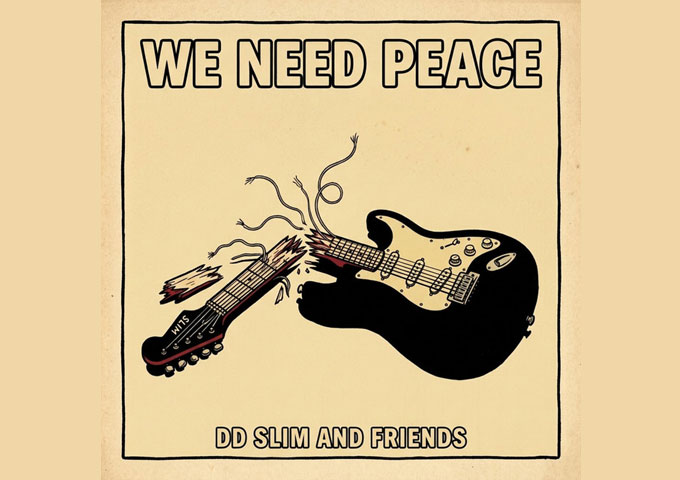
The message arrives before the guitar even finishes its first phrase, and it does not soften on the way in. DD Slim and Friends, the songwriting project of Detroit native Danny D, has released “We Need Peace (Rock Mix)”, a mid-tempo rock single that trades subtlety for directness and is stronger for it. Children’s voices fill in the spaces behind a lead vocal built for confrontation. The guitar work refuses to apologize for its own volume. What results is less a protest song than an exhausted demand, one that has run out of patience for diplomacy.
Danny D writes every lyric on this project and directs every arrangement decision, then hands the actual performing over to AI so the songwriting can carry the full weight of the work. The tagline he uses, Human Written. Robot Performed, is not a gimmick so much as a statement of priorities. The words come from a real life spent in and around music: a grandfather from Kyiv who tailored tuxedos for Fats Domino and Chubby Checker in the Bronx, a father who resettled in Detroit, and a childhood steeped in Motown, soul, rock, and rap. Danny D has spent decades on stages and in studios since, and that history shows up in the confidence of the writing, even when the performance itself is generated rather than played.
The visual world built around the project, populated by illustrated cartoon characters like DD Slim, Bobby Jay, Lola Love, Tojo, and Bad Bad Bunny, rendered in a hand-drawn 1970s animation style, is openly fictional. The songwriting is not. That distinction matters here. “We Need Peace” arrives as part of a larger body of work Danny D calls Songs for the Next World, and this particular entry reads as one of its most urgent statements yet.
Lyrically, the song opens on a note of confrontation, questioning why anyone would come at the narrator with hostility while the real casualties, the young, keep dying as the wealthy look away. There is a sharp jab at political theater, the sense that leaders distract from the real scoreboard while bombs continue to drop under the cover of empty promises. The chorus does not build toward its demand so much as arrive at it immediately and repeat it until it cannot be ignored: we need peace, no more war, no more hard times. It is blunt on purpose. This is not a song interested in poetic distance from its subject.
What elevates the writing past simple sloganeering is the way Danny D layers in images of childhood and innocence against the backdrop of violence. A reference to looking into a child’s eyes becomes a pivot point, the moment the song moves from anger into something closer to resolve. The imagery of twilight and breathing light suggests a narrator standing at the exact edge between darkness and dawn, unwilling to let despair have the final word even while acknowledging how close it sits. The recurring line that might does not make right functions almost like a thesis statement for the whole track, a rejection of the idea that force settles anything meaningful.
The song’s midsection turns communal, shifting from an individual voice to a collective one. Lines about giving blood to defeat enemies and violence looping endlessly speak to cycles that repeat across generations and geographies, never named specifically enough to belong to one conflict, which is likely the point. This is not a song about a particular war. It is about the structure of war itself, and the way ordinary people are asked to pay for decisions made far above their heads. There is a moment of near-defiant education skepticism folded into the later verses, a suggestion that formal narratives have failed to explain what people can see plainly with their own eyes, that something has gone deeply wrong and needs no further justification.
By the closing section, the song makes a deliberate turn toward tenderness. After multiple rounds of insistence, the demand softens into something disarmingly simple: I love you. Do you feel that. The bombs get named one final time, still obscene, still unacceptable, but the anger gives way to something warmer just before the track ends. That closing pivot, from confrontation to affection, is one of the more effective choices in the writing. It refuses to let the song end on despair or exhaustion. Instead it lands on connection, the implication being that love, however plainly stated, might be the only real counterweight to the violence described throughout.
The children’s voices that anchor the track are not incidental. They reinforce the song’s emotional center of gravity, the idea that whatever adults decide to do with power and weapons, it is children who inherit the consequences. Pairing those voices against a driving rock arrangement creates a genuine tension in the mix, innocence set directly against aggression, which mirrors the lyrical tension between fury and hope running through the entire song.
Since its June launch, the DD Slim and Friends project has seen listeners saving and adding tracks to their own playlists at a rate notably higher than typical for a new release, an early signal that the combination of pointed songwriting and distinctive visual identity is resonating beyond a niche audience. “We Need Peace (Rock Mix)” feels like a natural centerpiece for that momentum. It is direct where a lot of message-driven music hedges, and it commits to an emotional turn, from rage to love, that many songs in this vein never attempt.
Ultimately, “We Need Peace (Rock Mix)” works because it never pretends to be more complicated than it needs to be. It says the thing directly, backs it with a defiant sonic bed, an loops the demand until it becomes impossible to dismiss as background noise. For a project defined by the split between human authorship and artificial performance, this is a compelling example of what that combination can accomplish when the writing itself refuses to blink.
OFFICIAL LINKS: FACEBOOK – SPOTIFY – INSTAGRAM – YOUTUBE – TIKTOK