Bowery Park Project Boards the Western Train on ‘I Never Really Tried’
Jose Martin Jr. never planned to be the voice on his own records, only the hand behind them. A New York University honors graduate in film, music and English literature, he built songs for other people to sing. The industry told him credits come first, so in April he started releasing the work himself. Now I Never Really Tried arrives as a mid-tempo modern rock anthem with gritty guitars, a steady beat and soaring vocals. It is a song about the difference between breathing and living, and about how late a person can be to notice.
Jose Martin Jr. spent years convinced his songs belonged in somebody else’s mouth. He learned guitar as a teenager, discovered he could pull melodies out of the air and put words underneath them, and assumed that was the whole job. The plan was tidy and, on paper, sensible: write strong material, build out demos that sounded finished rather than apologetic, and place them with labels, publishers or a manager who could turn a catalog into a career. He never wanted the spotlight. He wanted the credit line.
The industry had other ideas. He was told, in the plainest terms, that a writer without prior credits and without any demonstrated pull on an audience is a difficult sell no matter how good the songs are. Catch-22s of that kind have ended plenty of careers before they started. Martin’s response was to go around the obstacle rather than argue with it. In April of this year he began releasing music under the name Bowery Park Project, not as a bid for stardom but as evidence. The reaction outpaced his expectations. Conversations with publishers followed, along with interest from Heavy Metal Records, operating under Revolver Records in the UK. The strategy is working exactly as intended, which is to say it is pointing back toward the original goal: getting these songs into the hands of signed artists who will cut them in their own style, release them, and carry them onto a stage.
‘I Never Really Tried’ is the newest piece of that argument, and one of the strongest. Parts of it, the melody and the broad shape of the arrangement, came to him a couple of years ago and then sat unfinished, the way good ideas often do until the right week arrives. He sat down in mid-January and finished the writing. What emerged is a mid-tempo rock anthem built on gritty guitar tone, a steady and unhurried beat, and a vocal that climbs rather than shouts. The tempo is the key decision. A faster arrangement would have turned this into a road song. At this pace it becomes something more uncomfortable and more honest: a man standing still long enough to take inventory.
The lyric opens on a Sunday afternoon, which is one of the loneliest settings available to a songwriter and a deliberate choice here. The narrator is knocking around his town with nothing to do, scanning the place for any reason to stay interested. Sunday is the day with no alibi. Work cannot explain the emptiness away. Into that quiet Martin drops the line the entire song hinges on, an accusation aimed inward before it is aimed anywhere else: if you are only breathing, you are not living, you are running a con on yourself. He follows it immediately with an instruction to take stock of the soul, and the diagnosis he finds is not dramatic. Nothing has collapsed. Something is simply fading behind the eyes, slowly enough that it could be mistaken for contentment.
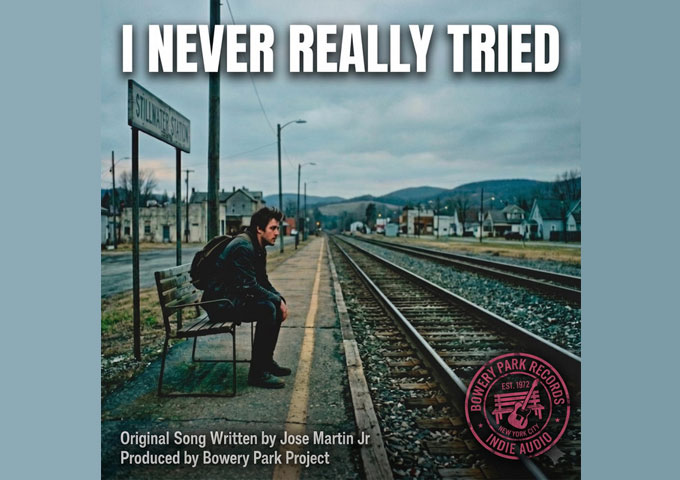
Escape arrives in the form of a train, and Martin uses that image with more care than the rock tradition usually affords it. The first is a Western Train, the classic American vector of reinvention, the one that promises a different self at the other end. He boards it without looking back, and the reason he gives folds the title back on itself. Living, he admits, is the one thing he has never really tried. The hook works as a confession rather than a slogan, and it is sharp precisely because it refuses self-pity. He is not claiming that life denied him anything. He is conceding that he never made the attempt.
The second verse widens the lens and darkens it considerably. Now he is among friends, still on a Sunday, still knocking around, but what he sees in their faces is the same absence he found in himself. This is the moment the song stops being personal and becomes a portrait of a place, a generation of people who have quietly stopped expecting anything. The imagery shifts from inventory to countdown. He starts counting grains of sand and acknowledges that dying is already moving toward him down the line. The train changes with it. What was a Western Train becomes a final train, and Martin lets the ambiguity stand. It might be departure. It might be death. The song is smart enough to know those can look identical from a distance when you have wasted enough years.
The bridge is where the writing does its most delicate work. Martin introduces a second figure, someone who once proposed leaving town together and for good, an offer he was too disordered in his own head to accept. That regret is handled in two lines and never explained further, which is the correct instinct. The listener does not need the details of the failure to feel its weight. What follows is the most affecting turn on the record: rather than mourning, he commits to seeing it through to the end, then promises to look her up on the other side. Whether that means later in life or after it is left open, and the openness is the point. Hope and eulogy occupy the same sentence.
Then the final section, where the song quietly rewrites itself. The train becomes the Sunday Train, which lands the whole narrative back in the ordinary afternoon where it began, no longer an escape route but the actual day in front of him. He refuses to look down the line, refuses to let the fear back in, and the hook mutates. The phrase that has run through the entire track in the past tense, the thing he never really tried, flips into the future. Really living becomes the only thing he is going to do, and Martin repeats the resolution until it sounds less like a boast and more like a man talking himself into it. Turning a confession into a vow using nothing but a change of tense is the kind of craft that separates a written song from an assembled one.
Martin is candid about his process, and he would rather lead with it than be ambushed by it. He is not a singer, so he uses AI for the vocal performances and discloses that on every release. Everything else is his. The lyrics are entirely his own work and copyrighted, the melodies and chorus foundations come from his own voice memos and keyboard parts, and the song structure and arrangement are his decisions. Analysis software consistently flags his catalog as human and AI hybrid, with pure AI probability falling below five percent. He points to public discussion from producers of the stature of David Guetta and Timbaland about how routine these tools have become at the highest levels of the business, with the difference being disclosure rather than practice. His challenge to skeptics is simple and fair: try building something with real hooks and real emotional architecture from prompting alone, and see how far it gets.
The honest measure of ‘I Never Really Tried’ has nothing to do with any of that anyway. Strip the arrangement away, put the lyric on a page, and it still works. Hand it to a signed rock act with a road-worn voice and it would sound like it had been waiting for them. That, ultimately, is the whole point of Bowery Park Project, and this track makes the case better than any pitch letter could.