
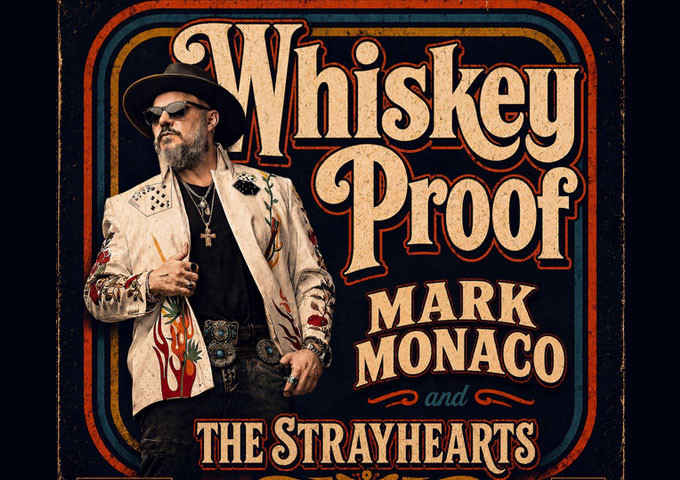
Mark Monaco and the Strayhearts Pour Out Heartbreak on “Whiskey Proof”
A Memphis-cut anthem for anyone still nursing a broken heart at last call Bourbon, brass, and bruised memory collide in a song built for the long night after love leaves Recorded where legends once stood, this single proves some pain simply won’t dilute.
Some heartbreaks refuse to fade no matter how many rounds you order, and Mark Monaco and the Strayhearts capture that exact stubborn ache on their new single, “Whiskey Proof.” The Texas-born artist, known for weaving traditional country with Bakersfield grit, Memphis soul, and Tex-Mex color, has delivered a song that feels like it was poured straight from a jukebox in 1968 and somehow still tastes fresh today.
The setting matters here as much as the songwriting. “Whiskey Proof” was tracked at the storied American Recording Studio in Memphis, the same room where Elvis Presley, Dusty Springfield, and B.B. King once made music history. That lineage isn’t just trivia for liner notes. You can hear it in the warmth of the recording, in the way the instrumentation breathes instead of crowding the vocal, in the sense that this song was built to last rather than trend. Monaco clearly understands that recording in hallowed rooms comes with a responsibility to the songs made there before him, and he honors that history without imitating it.
Musically, “Whiskey Proof” rides a mid-tempo Americana groove that feels organic and unhurried, the kind of arrangement that lets a story unfold rather than rushing toward a hook. Michael Guerra’s accordion work threads through the track with a Tex-Mex warmth that adds texture without ever overwhelming the mix, while Hector Tellez Jr.’s nylon-string guitar brings a soft, almost cinematic intimacy to the verses. Together, these elements give the song a sound that is distinctly regional yet universally relatable, a blend that mirrors Monaco’s own artistic identity as someone who refuses to be boxed into a single genre.
Lyrically, “Whiskey Proof” is a masterclass in the classic barroom lament, but it earns its place among that tradition rather than simply borrowing from it. The narrator sits under neon light, surrounded by noise and people who have no idea what he’s carrying, and that opening image immediately establishes isolation within a crowd, a feeling anyone who has nursed heartbreak in public will recognize instantly. From there, the song builds its central metaphor with real craftsmanship. The narrator isn’t just drinking to forget. He’s testing whether alcohol can actually out-muscle memory, and the song’s cleverest move is flipping the expected outcome. Traditionally, whiskey is the strong thing, the substance measured by its proof. Here, Monaco reverses the equation entirely, suggesting that the memory of this woman is somehow stronger and more resistant than the liquor meant to wash it away. That inversion becomes the emotional engine of the whole track, turning a familiar drinking song trope into something more specific and more devastating.
The bourbon imagery throughout does double duty as both comfort and cruelty. It goes down warm, familiar, almost soothing, yet it burns on the way, mirroring exactly how the memory of this woman operates on the narrator. She comforts him in recollection even as she wounds him in absence. That tension between warmth and pain is where the song finds its emotional core, and it’s handled with a restraint that feels mature rather than melodramatic. There’s no self-pity theater here, just a man being honest about what he’s feeling while trying to numb it, and failing.
The bartender exchanges scattered through the song serve as more than scene setting. They function almost like a call and response with fate itself, a small ritual of ordering another round that becomes a stand in for the larger, more painful ritual of trying and failing to move on. Each request for one more round is really a request for one more moment of relief, and the repetition of that gesture throughout the song reinforces the cyclical, trapped nature of heartbreak. It’s not a straight line toward healing. It’s a loop, and Monaco captures that loop with real precision.
What elevates the song further is the honesty about where the narrator’s mind wanders when he’s alone with his thoughts. Rather than staying fixed only on his own suffering, he imagines her out there living a new chapter, possibly with someone else, and that imagined scene sharpens his own pain rather than distracting from it. It’s a small but powerful songwriting choice, because it acknowledges that heartbreak isn’t just about missing someone. It’s about grappling with the reality that life continues for them too, indifferent to your grief.
By the time the song reaches its late night imagery of closing time, there’s a quiet acceptance that no amount of bourbon is going to resolve this. The whiskey offers temporary relief, maybe even false hope for a night, but morning and memory always return. That closing sentiment gives the song emotional weight beyond a simple drinking anthem. It becomes a meditation on grief, patience, and the particular kind of loneliness that follows love once it’s gone.
Mark Monaco and the Strayhearts have built their identity on real stories delivered with rock and roll soul, and “Whiskey Proof” fits that mission perfectly. It’s a song rooted in the kind of timeless songwriting that doesn’t chase trends, drawing instead from the tradition of storytellers who understood that a song should still mean something long after the final note rings out. Whether encountered in a dance hall, on a long stretch of highway, or through headphones at the end of a hard day, “Whiskey Proof” offers listeners a reminder that some heartbreaks are simply resistant to dilution, no matter how many rounds you order.