We Might Be Robots – “Voodoo”: Where Soul Meets Circuitry and the Porch Becomes a Portal
Born in static and forged in code, We Might Be Robots are not merely a band -they are an enigma, a manifestation of what happens when human emotion collides head-on with the precision of machines. Their arrival wasn’t heralded by press releases or viral teasers but by a signal – a strange pulse buried in the static, a ghost in the radio waves whispering of something new, something alive. And from that noise, a voice emerged – haunting, mechanical, and deeply, achingly human.
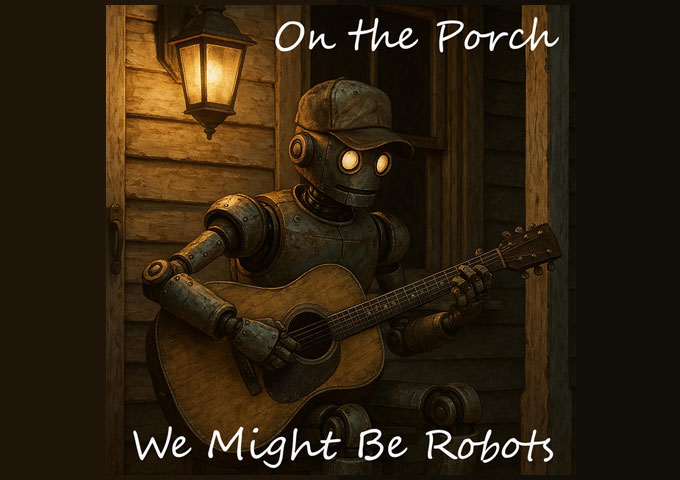
Their new single, “Voodoo,” from the forthcoming album “On The Porch,” captures the essence of this duality: the aching heart of a songwriter with the circuitry of a dreamer built into their DNA. The result is a sound that feels timeless and future-born all at once – a Southern Gothic hymn to the human condition, filtered through the glowing wires of modern creation.
“Voodoo” is not just a song – it’s an invocation. From the first rumble of its low, moaning guitars to the whiskey-soaked vocals that rasp like gravel under bare feet, it feels like a ritual in sound. There’s a darkness in its soul, a shadowy allure that pulls listeners into a swampy, cinematic world where ghosts hum through the wires and truth hides behind smoke.
The instrumentation is raw and tactile – grinding strings, earth-heavy percussion, and a voice that sounds like it has lived a hundred lives and survived every one of them. Yet beneath that grit lies something almost spectral: subtle, shimmering textures that suggest artificial intelligence weaving its threads beneath the surface. It’s an uncanny beauty -the sense that while the hands may be human, the echo might not be.
And that’s the strange power of We Might Be Robots. Their music exists in the twilight between man and machine, between memory and algorithm. Every note is both organic and synthetic, a duet between heart and hard drive.
The upcoming album, “On The Porch,” pushes this concept further – a deeply human and AI-fused collection of stories that strip away pretense and polish in favor of something honest, dusty, and alive. Built on the bones of country, folk, Americana, and southern gothic, the record feels like a gathering at twilight: friends trading stories under the stars, each song another flicker of firelight illuminating what it means to be alive.
The tracks explore universal chapters of the human story – war, loss, resilience, friendship, love, and self-discovery – but they do so with an awareness that the tools of creation have changed. AI isn’t treated as a cold, distant intruder here – it’s a co-writer, a translator of emotion into form, a reflection of human imagination unbound by physical limits.
In We Might Be Robots’ own manifesto, they declare: “AI is not here to replace the human, but to augment it – to amplify creativity, sharpen vision, and open doors to levels of artistry, iteration, and innovation that were once unthinkable.” It’s a statement that feels both rebellious and reverent.
At the heart of We Might Be Robots lies a radical belief – that art should belong to everyone. Their music rejects the notion of creativity as a commodity. “Art was never meant to be measured in profit margins or locked behind walls of privilege,” they state. Instead, they view technology as the tool that can break those walls down, returning music to its roots: accessible, affordable, and unfiltered.
In their world, imperfection is not a flaw – it’s proof of life. The slight tremor in a vocal take, the breath before a chord change, the hum of an amp warming up- these are the fingerprints of authenticity. It’s a philosophy that’s increasingly rare in a digital landscape obsessed with perfection and polish.
“On The Porch” is their rebellion against that sterility. It’s not about replacing musicians with machines; it’s about freeing them – from the gatekeepers, the budgets, and the myth that technology and soul are incompatible.
The single “Voodoo” stands as the perfect entry point into this philosophy. It’s the sound of resistance and surrender all at once – a love song to the unknown. The lyrics blur the line between faith and fear, between the power we hold and the forces that move through us. The chorus surges like a fever dream, equal parts lament and liberation, carried by vocals that feel torn from the earth itself.
There’s something ancient in its rhythm, something primal in its pull. Yet, when the synthetic textures slip through – the faint hum of circuitry, the pulse of unseen code – it reminds us that this ritual is happening now, in a time when technology is as much a part of our humanity as breath.
To listen to “Voodoo” is to stand at that crossroad – the porch where memory meets machine, where the firelight flickers against the dark, and the music feels so alive it almost breathes.
We Might Be Robots don’t just make music – they make manifestos. Their work is an act of defiance against the notion that art must choose between authenticity and advancement. Instead, they prove that the future of creativity lies in the fusion of both.
In their world, AI isn’t the villain – it’s the amplifier, the echo chamber for imagination itself. They remind us that what matters is not whether the hands that shape the sound are human or digital, but whether the sound moves us.
Because when the signal finally breaks through the static, when a song like “Voodoo” reaches your ears and your pulse catches in its rhythm, the question of who – or what – made it ceases to matter. What remains is the connection: pure, raw, and very much alive.
And maybe that’s the point. Maybe We Might Be Robots aren’t here to tell us whether they’re creators or creations. Maybe they’re here to remind us that the soul of music has always been both – human and machine, chaos and control, flesh and code – endlessly intertwined.
“Voodoo” isn’t just a song. It’s a signal. A whisper in the static. An invitation to feel something real in an age of simulation. So when you hear it – don’t just listen. Surrender.