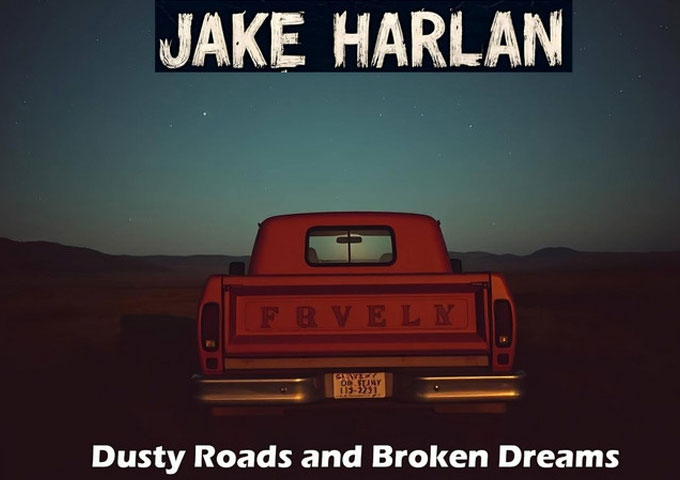
Jake Harlan Paints the Heartland in Melancholy Gold with “Dusty Roads and Broken Dreams”
In modern country, where music often swerves too sharply between pop gloss and outlaw grit, Jake Harlan drives straight down the middle—steady, dust-streaked, and real. His latest single, “Dusty Roads and Broken Dreams,” is a tender yet rugged ballad that captures the emotional core of small-town America: the lingering ache of lost love, the pull of familiar roads, and the quiet hope that maybe, somewhere out there, redemption still waits at the end of a long drive.
For Harlan, authenticity isn’t a marketing angle—it’s his lifeblood. As an independent country artist, he’s carved his place by balancing raw feeling with undeniable hooks, proving that honest storytelling can still sit comfortably alongside modern, radio-ready production. Following the stomping energy of his recent single “Kickin’ Up the Dust,” Harlan slows the tempo but raises the emotional stakes. “Dusty Roads and Broken Dreams” is less about heartbreak as spectacle and more about heartbreak as geography—a place you know too well but can’t quite leave behind.
From its opening line—“Out on these dusty roads, where the neon lights fade”—Harlan sets the tone with a cinematic sense of desolation. The production builds around a mid-tempo groove that feels like the steady hum of tires on asphalt. Layered guitars shimmer beneath a gently driving rhythm section, evoking both motion and melancholy. There’s a touch of Southern rock grit in the tone, but the soul of alt-country beats at its center: patient, vulnerable, and unhurried.
Harlan’s voice is the glue that holds the track together. Warm, worn, and quietly resolute, it carries the kind of emotional honesty that doesn’t need theatrics to be felt. There’s a subtle rasp that suggests both experience and endurance—a man who’s seen his share of late-night barrooms and long drives home under indifferent stars. The vocal phrasing dances delicately between reflection and release, especially in the chorus, where he repeats “Whiskey on my lips, your name on my mind,” as if the act of singing might finally exorcise the memory.
Lyrically, “Dusty Roads and Broken Dreams” unfolds like a midnight confession on a backroad. It’s steeped in imagery that feels lived-in rather than imagined—beer cans scattered on a truck bed, neon fading in the rain, a honky-tonk echoing with ghosts of laughter. These are classic country symbols, yet Harlan reclaims them from cliché through sheer sincerity. The song isn’t about nostalgia for nostalgia’s sake; it’s about the cost of it.
The recurring motif of motion—driving through the night, chasing ghosts, wandering toward something unnamed—anchors the track in a restlessness that defines much of rural American life. Each verse circles the same emotional horizon: the tension between leaving and longing, between the freedom of the open road and the weight of what’s been left behind.
The line “Broken dreams in the rearview, drivin’ through the night” is emblematic of Harlan’s craft. It captures not just heartbreak, but the unspoken hope that comes from continuing to move forward even when you don’t know where you’re headed. The truck becomes a metaphor for survival—the vehicle through which love, regret, and resilience all travel together.
Musically, the chorus carries the emotional climax without overstatement. The hook feels inevitable, as if it had been sitting on the radio airwaves for decades waiting for someone to rediscover it. The guitar lines swell just enough to lift the melody skyward, while the percussion keeps the song tethered to the earth. It’s that balance between altitude and asphalt that makes “Dusty Roads and Broken Dreams” so compelling—it reaches for the heavens but never loses sight of the dirt under its wheels.
The repetition of “Out of sight, but not out of heart” hits like a mantra, the kind of phrase that listeners will find themselves humming long after the last chord fades. It’s a simple truth expressed with poetic restraint: love may be gone, but it never fully disappears.
There’s a quiet brilliance in the way Harlan uses familiar country tropes—whiskey, pickup trucks, old hometowns—and transforms them into vessels of emotion rather than decoration. When he sings “Maybe someday I’ll turn this truck around, find my way back to that old hometown,” it doesn’t sound like resignation; it sounds like acceptance. It’s a moment of clarity that suggests maturity rather than melancholy.
That’s the secret to Harlan’s appeal. He writes from the perspective of someone who has lived the stories he tells but refuses to drown in them. His heartbreaks aren’t dirges; they’re hymns of endurance. This is country music not as escape, but as reckoning—where every heartbreak becomes a mile marker and every melody, a map back to yourself.
As Jake Harlan continues to make his mark as an independent artist, his trajectory feels as deliberate as his songwriting. His ability to fuse Southern rock’s grit with Americana’s soul positions him as one of the genre’s most promising torchbearers. Through streaming platforms, social media engagement, and good old-fashioned word-of-mouth, Harlan has been cultivating an audience that values truth over trend.
Both “Kickin’ Up the Dust” and “Dusty Roads and Broken Dreams” show different sides of his artistry—one a fist-pumping anthem, the other a quietly devastating reflection. Together, they form a kind of emotional diptych, proving that heartland storytelling can still sound fresh, alive, and unmistakably human.
“Dusty Roads and Broken Dreams” isn’t just another country ballad—it’s a statement of identity. It reaffirms that the real power of country music lies not in perfection, but in presence. Harlan’s song doesn’t tie things up neatly or offer false hope; instead, it lingers, echoing like the fading tail lights on an empty stretch of highway.
If Jake Harlan is indeed driving toward something greater—and all signs suggest he is—then this song is his compass. It’s proof that amid a crowded landscape of formulaic hooks and shallow sentiments, there’s still room for a songwriter who can make you feel every grain of dust and every crack of heartbreak.
In “Dusty Roads and Broken Dreams,” Harlan doesn’t just sing about the miles he’s traveled—he takes you with him. And by the time the last note fades, you’ll find yourself still chasing those same dusty roads, dreaming right beside him.
OFFICIAL LINKS: FACEBOOK – SPOTIFY – INSTAGRAM – YOUTUBE – TIKTOK